
There’s a term in sociology, social anomie, that describes the disconnect a society feels when…
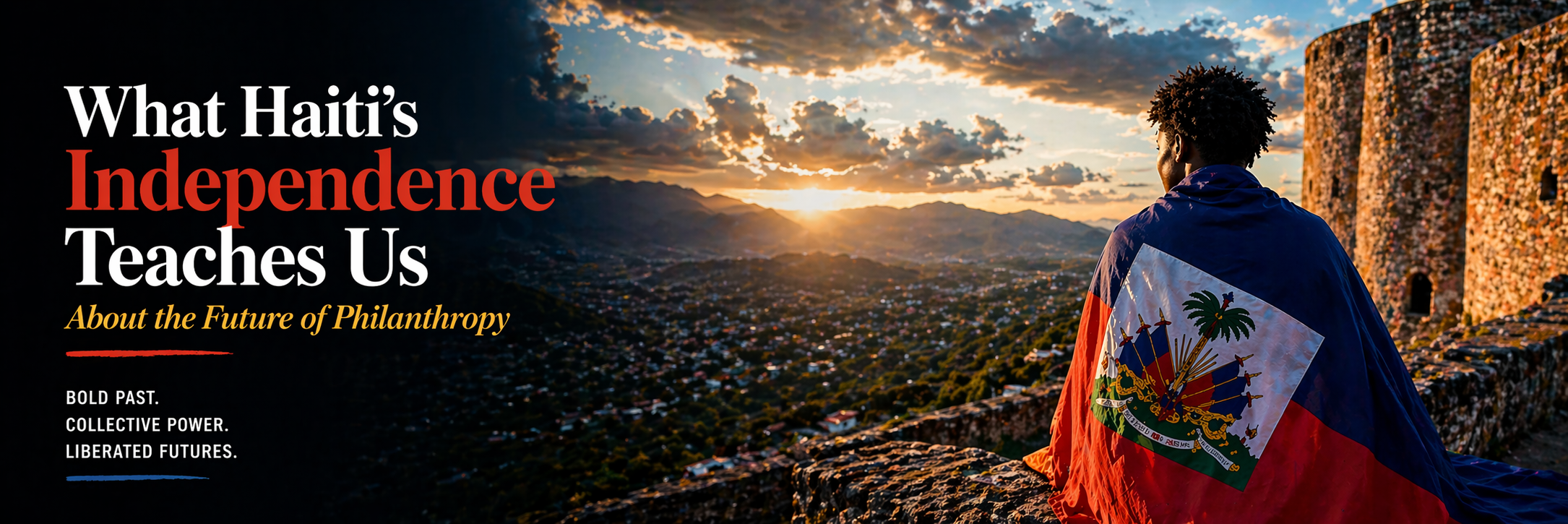
What Haiti’s Independence Teaches Us About the Future of Philanthropy
Every year in January, Haitian independence is celebrated as a historical event, a special kind of revolution, and a world-first phenomenon, and as a metaphor for black freedom. However, often not as a model for current power and decision-making.
Haiti’s independence was not only a break from the colonial experience, but also a declaration by people who realized that freedom without control over one’s destiny is not freedom at all. Today, Haiti remains one of the most controlled countries in the world, politically, economically, and philanthropically.
As we enter 2026, Haiti’s independence challenges us all to ponder how self-determination manifests in contemporary philanthropy.
Too often, the philanthropic systems engaging Haiti operate on assumptions that directly contradict the very principles of independence. Funding priorities are set by external stakeholders. Definitions of success are imported. Timelines imposed. Accountability flows upward to donors rather than out toward communities.
In this context, philanthropy runs a real risk of being no more than a soft version of control; well-intentioned but structurally misaligned.
Picturing Haiti’s independence challenges philanthropy at its core to redefine itself: not as a savior or manager, but as a supporter of sovereignty. This necessitates a shift from charity to solidarity, from the extraction of outcomes to the investment in systems, and from short-term visibility to long-term trust.
Solidarity-based philanthropy means that Haitian organizations are not vehicles for advancing donors’ agendas. They are entities with their own histories, with their own constituents that they are responsible for. To support them requires embracing uncertainty, funding institutional development, and deferring decision-making to locals, even and especially when those decisions run counter to donor preference.
Independence equally reminds us of the price of freedom. Haiti had won its independence at the cost of its indebtedness and its isolation. In contemporary society, many Haitian institutions pay this price by operating in a system that expects perfection but offers no stability.
If philanthropy wants to keep the spirit of Haiti’s independence, it has to let go of control. After all, freedom cannot be subcontracted.
Related Posts



This Post Has 0 Comments