

Inside the Research: What Dr. Watson Escarment Learned Asking NGO Leaders to Name What’s Broken
There’s a term in sociology, social anomie, that describes the disconnect a society feels when its shared norms start to break down: a loss of cohesion, a loss of trust, a sense of drift. It’s not a phrase most people use in everyday conversation. But when Dr. Watson Escarment sat down with dozens of NGO leaders across Haiti for his doctoral research, he found that almost none of them knew the term either, and nearly all of them were describing it anyway.
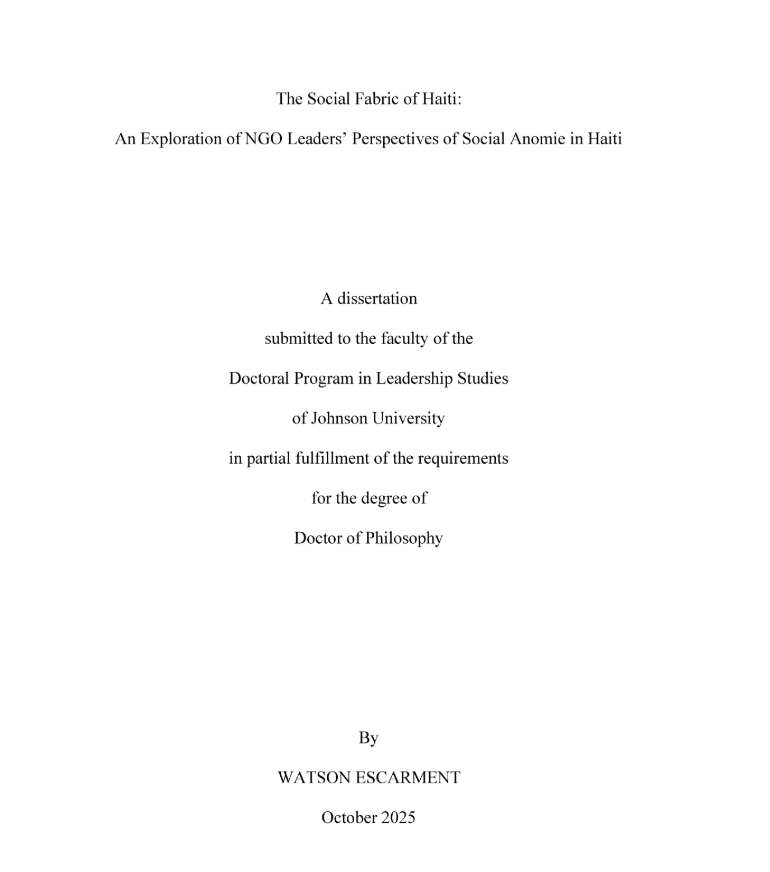
That contradiction sits at the center of Watson’s thesis, The Social Fabric of Haiti: Exploring Leaders’ Perspectives of Social Anomie, and of the conversation he had with Debbie Jean-Jacques for Centre NGO’s Reimagine Philanthropy + Haiti series. What follows is a look at how that research came together, and what it found.
Not an Outside Observer
Watson didn’t come to this topic as an outside observer. Born in Haiti, he migrated to Miami at ten years old, into a cultural moment where being Haitian carried real stigma. “You either fought, or you ran as a Haitian,” he says of that period, and he chose to fight. Years later, a nudge from his church community pulled him back to Haiti after the 2010 earthquake, on a trip that turned into nearly fifty over the following decade, doing leadership training with local communities.
When it came time to choose a doctoral research topic in organizational leadership, he didn’t look far. He’d spent a decade doing the same kind of on-the-ground service work his research subjects do. So he built the study around that vantage point: not policymakers, not international donors, but the leaders working day-to-day inside Haiti’s nonprofit ecosystem.
Conversations, Not Surveys
Watson had thirteen or fourteen base questions going in, but he made a deliberate choice early on: no survey, no form. Just conversation, sometimes over Zoom, sometimes WhatsApp, sometimes in person, and sometimes stretched across two or three sittings because, as he puts it, “Haitians are storytellers.” An hour wasn’t always enough, and he was fine with that. He describes each participant as painting a picture with him, some of it heartbreaking, some of it funny, some of it quietly hopeful.
The three core questions anchoring those conversations: How do NGO leaders describe their lived experience of social anomie? What do they see as contributing factors? And what role does government play in it? From there, the conversations opened into how people saw Haiti across three eras, before the 2010 earthquake, after it, and after the assassination of President Jovenel Moïse.
Six Findings, and a Surprising Thread of Optimism
The findings that came out of those conversations:
People are living social anomie without naming it. Participants described the disconnect in their own words, through the lens of trauma, mistrust, or day-to-day struggle, without ever using the term itself.
A longing for a Haiti of the past. Many participants, especially those who’d spent most of their lives in the country, spoke about an earlier era with real nostalgia, a pattern Watson notes isn’t unique to Haiti, but ran deep here.
Government’s role, or absence of one, came up almost universally. Whether it was active harm or simply the vacuum left by dysfunction, this was the most consistent theme across every interview.
Even so, a real thread of optimism. Despite everything, several participants pointed to the idea that meaningful change could start with a single leader, while others held out hope for a broader shift.
A quiet, unglamorous layer of people making change happen anyway, in education, healthcare, community organizing, often without much visibility, and sometimes deliberately staying anonymous for their own safety.
And a foundational critique of Haiti’s political structure itself, not just who holds office, but the system that rewards being well-connected and well-spoken over a track record of service.
That last point led to one of the more pointed exchanges in the interview, where Debbie and Watson push past hope and into structure: “If you find that one person, and then you put that person on top of this system that exists today, that person won’t stand for long.” For Watson, the work has to start at the foundation, not with a single leader dropped into a system that hasn’t changed.
Advice for NGOs and Funders
Watson closes with three pieces of advice he heard echoed across nearly every conversation, aimed at anyone working in or funding Haiti’s nonprofit sector:
- Listen first. As one participant told him bluntly: go there and shut up for a while.
- Stop duplicating effort. Too many organizations are doing the same narrow work in isolation when collaboration could do something bigger.
- Work yourself out of a job. The goal of NGO work, in Watson’s view, should be building communities toward independence, not sustaining dependency for years or generations.
What’s Next
Watson’s next research idea, floated in the conversation, is an ethnographic study, someone embedded in a community for six months to a year, observing daily life rather than interviewing after the fact. He’s also interested in a deeper look at the diaspora’s role beyond remittances: what a structured, collective diaspora contribution to Haiti could actually look like.
The full thesis is now available, link below. Watch the full conversation for the rest of the story, including the moment Watson has to answer, honestly, whether all of this research left him more optimistic about Haiti’s future, or more of a realist.
Watch the full interview
Read the full thesis
Related Posts

This Post Has 0 Comments